Waiving prescription charges for Ciprofloxacin for Meningococcal disease response
Dear colleagues
Meningococcal disease outbreak affecting the University of Kent and the Canterbury area
Update on the evolving situation involving multiple cases of invasive meningococcal disease linked to the University of Kent, Canterbury and local secondary schools. NHS England » Outbreak of meningococcal disease linked to University of Kent and the area of Canterbury
Summary of immediate actions
- General Practice prescribers must issue paper FP10 prescriptions and endorse the item for prophylactic Ciprofloxacin chemoprophylaxis as a ‘free supply’ by writing ‘FS’ plus the prescriber’s initials or signature
- Community pharmacies must dispense FS-endorsed prescriptions without collecting a charge
- Provide refund advice only where FS was incorrectly omitted and a charge was paid
- Use the helpline for non-clinical enquiries
- Symptomatic individuals need urgent referral to urgent care.
Do not
- Issue private prescriptions for chemoprophylaxis (GP or community pharmacy)
- Provide chemoprophylaxis outside UKHSA-defined cohorts
- Collect prescription charges from patients with an FS endorsement.
Action for General Practice:
Chemoprophylaxis: Chemoprophylaxis for patients should be offered for the eligible cohort according to clinical guidance: Meningococcal disease: guidance on public health management – GOV.UK
Issuing a prescription
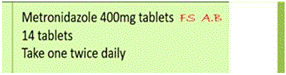
While free supply is permitted for STI and TB, there is currently no functionality in GP clinical systems to support free supply for this indication. Therefore, prescribers must issue paper FP10 prescriptions for oral ciprofloxacin chemoprophylaxis. When generating an FP10 paper prescription (printed or handwritten), the initials ‘FS’ and the prescriber’s initials or signature should be annotated alongside the item being prescribed.
Example of how the ‘FS’ endorsement countersigned by the prescriber should appear on FP10 forms
Those eligible for a free prescription (which is subject to change) covers all those currently offered prophylactic Ciprofloxacin as part of this outbreak, specifically:
- All University of Kent students and staff living /working in Halls of residence on Canterbury Campus
- All those who attended Club Chemistry between Thursday, 5 March 2026 to Sunday, 15 March 2026
- Sixth forms at schools and colleges where there has been a probable or confirmed case
- Others identified as close contacts for whom prophylaxis is appropriate.
Guidance on how prescribers should apply this endorsement, for the original defined uses, can be found on the Community Pharmacy England website.
The prescription charge will be waived for the period March Thursday 5 March 2026 to Tuesday, 21 April 2026. This may change as the situation evolves.
Action for community pharmacy:
- Chemoprophylaxis: Patients may present at community pharmacies with NHS prescriptions for chemoprophylaxis.Community pharmacies must dispense the prescription in line with usual practice. There is no commissioned service for community pharmacy to initiate chemoprophylaxis for NHS patients.
A prescription charge exemption using the ‘Free supply for specified use (FS)’ endorsement has been approved for all prescriptions presented for this purpose. Guidance on how prescribers should apply this endorsement and how pharmacy teams should correctly submit ‘FS’ endorsed prescriptions can be found on the Community Pharmacy England website.
Refunds for patients who have already paid:
After the date an oral ciprofloxacin chemoprophylaxis prescription is dispensed and collected: If a patient from the affected cohort has already paid a prescription charge and requests a refund, they can write to the hc5refundquery@nhsbsa.nhs.uk to request a refund.
Patients should include a covering letter outlining their circumstances and their proof of payment, an FP57 or till receipt, where they retained this. Or they can telephone 0300 330 1343.
- Signposting and advice: Worried students, parents, or members of the public may seek advice from their community pharmacy teams. If an individual believes they may have been exposed, please advise them to follow UKHSA instructions rather than seeking private antibiotics. Community Pharmacy teams are advised to remain vigilant for symptoms of meningococcal disease. Symptoms may include:
- Fever
- Severe headache
- Neck stiffness
- Photophobia
- Non‑blanching rash
- Vomiting
- Confusion, drowsiness, or altered consciousness
- Limb pain, cold extremities, or mottled skin (potential early sign)
Anyone presenting with symptoms suggestive of meningitis (this could include patients referred into Pharmacy First through the usual pathways) or rapidly deteriorating illness, should be directed to urgent care via 999 or A&E for immediate emergency assessment. Any concerns should be documented and escalated through local clinical governance routes if appropriate.
Please ensure that all pharmacy staff are kept up to date on the most recent UKHSA guidelines regarding the management of this outbreak to support patient awareness and care navigation.
A patient helpline, run by UKHSA, is now available for general enquiries. Patients can phone 0344 225 3861, Monday to Friday from 9am to 5pm if they have no symptoms but are concerned, they have been in contact with a confirmed case.
- Vaccination: We are asking for general practice to support the NHS in delivering the MenB vaccination to a small cohort of people in response to the meningitis outbreak. The GP offer is only for students at the University of Kent who are unable to access the local clinics in Canterbury, for example they have already returned home. There is no commissioned community pharmacy service for NHS patients. If an eligible individual presents at general practice and has not received a vaccine through a local vaccination clinic, we are asking practices to administer MenB vaccines on request. If an eligible patient presents, who is not registered with a General Practice, they can be advised to either:
- Contact a local GP and register as a permanent patient or
- Register as a temporary resident
We are assured that NHS stock levels of the vaccine are adequate to meet the need of the defined eligible cohort.
Alternative vaccine stock (20,000 doses) has been made available for individuals requesting private vaccination.
A GP letter was published by NHSE outlining the MenB vaccination offer for University of Kent students.
Guidance on who is eligible for an NHS Meningitis B vaccine is available on the UKHSA website.
- Independent Prescribing: Pharmacist prescribers are advised not to issue private prescriptions for chemoprophylaxis. UKHSA is centrally coordinating chemoprophylaxis, so community pharmacies are advised not to issue private prescriptions for meningococcal disease prophylaxis requests.
This is essential to:
- Prevent individuals bypassing UKHSA’s clinical prioritisation process
- Ensure UKHSA are aware of all potential exposure cases to support with contact tracing
- Ensure prophylaxis is limited to the appropriate cohorts
- Preserve supplies of antibiotics
- Avoid inappropriate use outside national guidance
- Support antimicrobial stewardship.
Thank you for your continued vigilance and support in responding to this fast‑moving incident. The role of general practice and community pharmacy in early identification, public reassurance, and maintaining safe antimicrobial practice is vital.